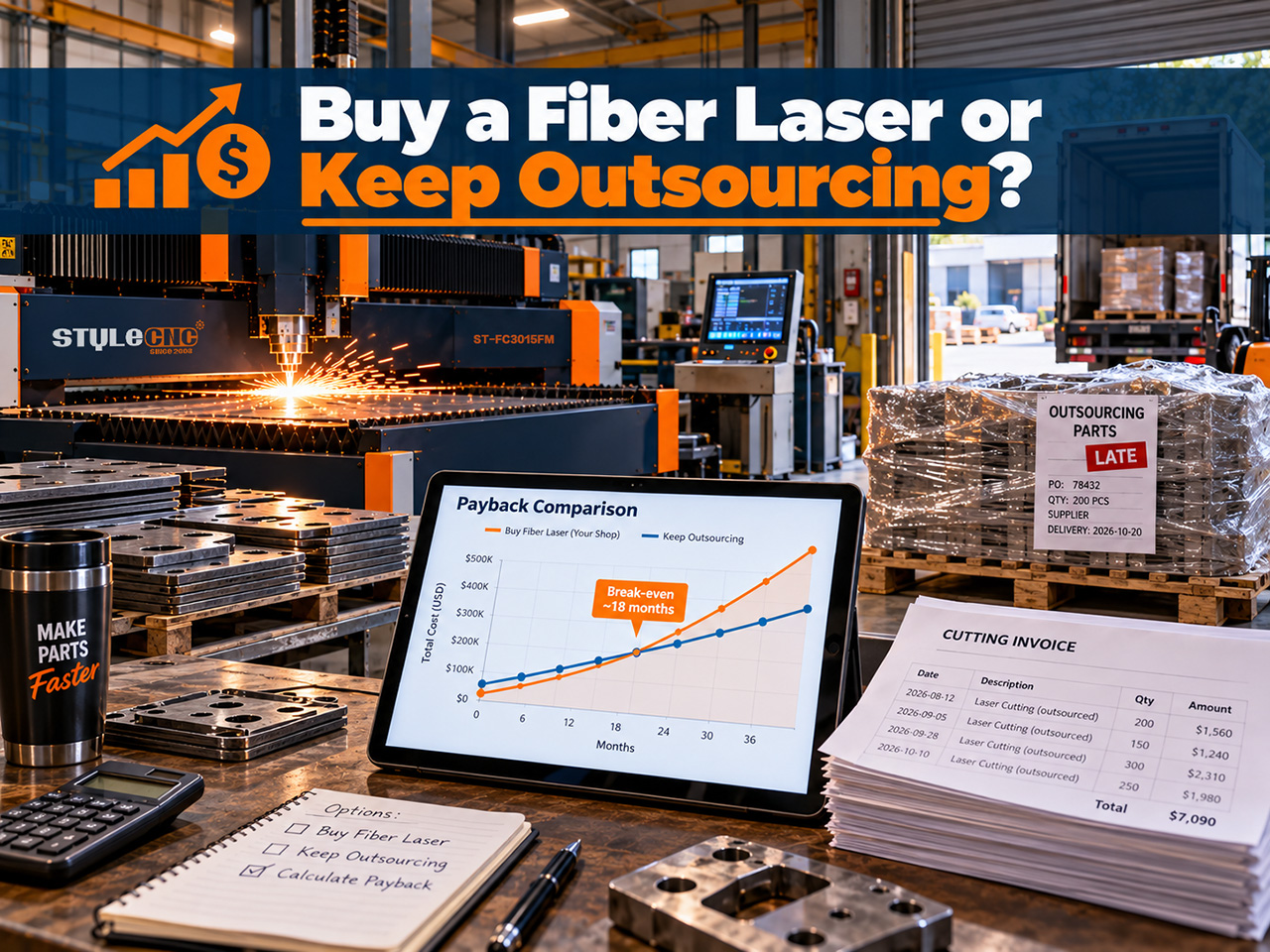
Many fabrication shops reach the same point: the laser cutting invoices keep growing, parts arrive later than promised, and someone asks whether it is time to buy a machine. The question sounds simple, but the answer depends on a handful of numbers most shops already have. This guide shows how to find your payback period, which hidden benefits belong in the decision, and when outsourcing is still the smarter choice.
What Laser Cutting Services Really Cost
Laser cutting services price their work by machine hour, per part, or per sheet, but behind every quote sits an hourly rate. Depending on region, material, and machine, job shops commonly charge somewhere around $90 untuk $200 per machine hour for pemotongan logam, with lower rates in regions with cheaper labor and energy.
The cutting rate is only part of the invoice:
⦿ Material is usually resold with a markup to cover purchasing, storage, and scrap.
⦿ Setup and programming fees apply per job, and small orders hit minimum charges.
⦿ Freight, packaging, and rush fees add up, especially on urgent prototypes.
⦿ Every rejected or late part costs internal time chasing, reworking, or waiting.
One way to see the scale: a shop buying 60 hours of cutting a month at $130 an hour spends about $7,800 every month, before material and freight. That figure alone is in the range of a monthly finance payment on an entry or mid-range fiber laser. If you need a reference for what that machine would cost, see berapa kos mesin pemotong laser.
Turning invoices into machine hours
Vendors rarely list hours on an invoice, so you may need to estimate them. Divide the cutting charges by the vendor's hourly rate if they quote one, or ask 2 vendors to quote a typical month of parts on a machine-hour basis. Some shops simply run a few representative drawings through nesting software to get cutting times. Even a rough figure is enough to place you in the right band.
Monthly Outsourcing Spend Thresholds
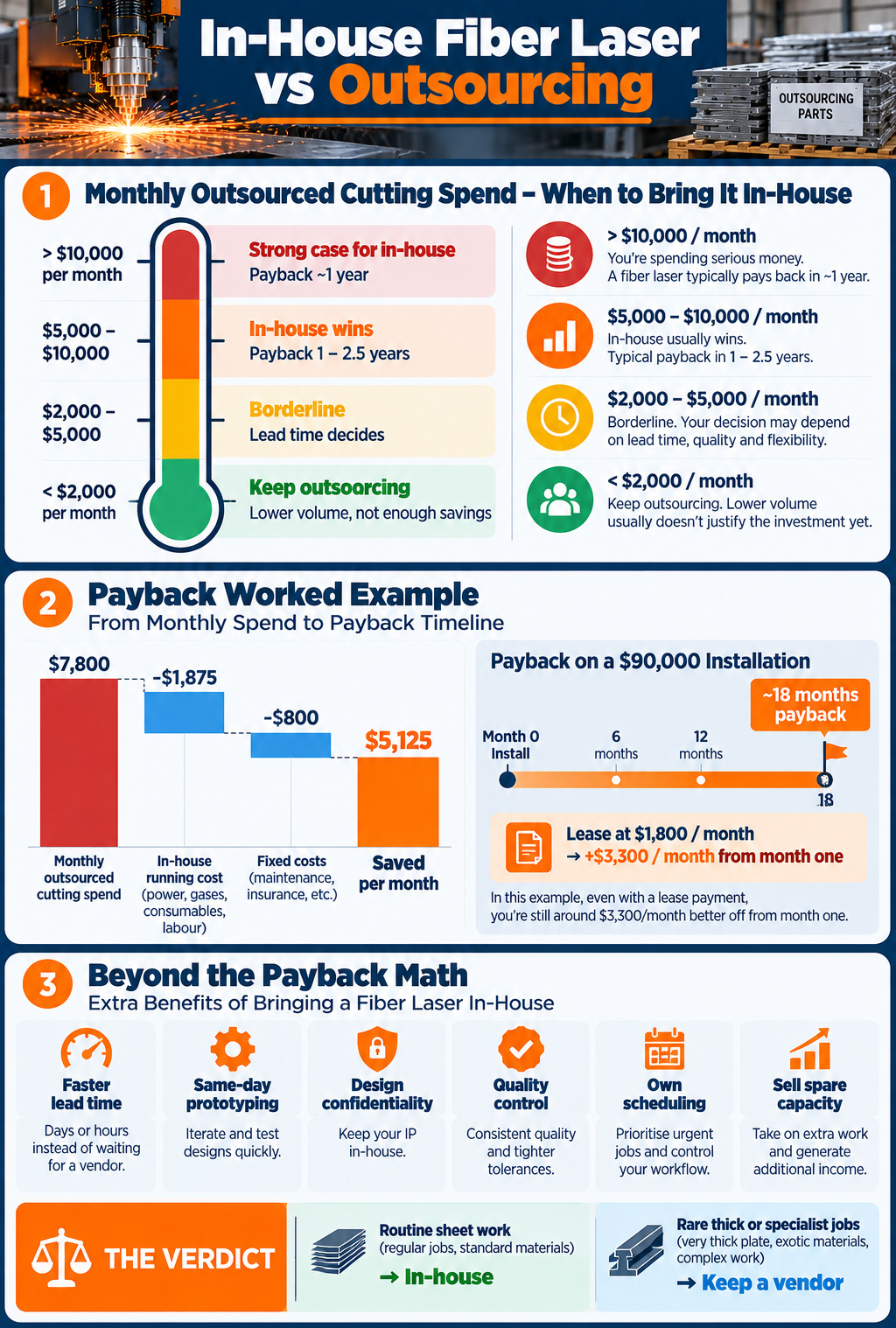
The single best predictor of payback is how much you already spend on cutting each month. The table below uses an illustrative installed cost of about $90,000 and in-house running costs near a quarter of the outsourced rate.
| Monthly Outsourced Cutting Spend | Typical Payback on a ~$90,000 Install | Usual Verdict | Pengukuran |
|---|---|---|---|
| Under about $2, 000 | Rarely within the machine's useful life | Keep outsourcing | Twelve months of cutting invoices |
| Kenali Kami $2,000 kepada $5, 000 | Roughly 2.5 to 5 years | Borderline; lead time and prototyping value decide | Share of orders delayed waiting on parts |
| Kenali Kami $5,000 kepada $10,000 | Roughly 1 to 2.5 years | In-house usually wins | Monthly spend trend over the last year |
| Over about $10,000 | Often around a year | Strong case for in-house | Cutting hours bought per month |
Use cutting charges, not total invoice value, when you place yourself in the table. Material you would buy anyway does not count as a saving, although the vendor's material markup does. Look at the trend as well as the average: a shop whose outsourcing spend has doubled in a year is buying for where it is heading, not where it was.
Payback Period Worked Example
Here is the full calculation for the illustrative shop above. Replace each line with your own figures; the method matters more than these values.
| Line (illustrative shop) | Sebulan | Nota |
|---|---|---|
| Current outsourced cutting: 60 hours at $130 | $7,800 | Cutting charges only, material excluded |
| In-house running cost: 60 hours at about $31 | - $ 1,875 | Power, air assist, consumables, maintenance, operator |
| Fixed in-house costs: space, insurance, software, service | - $ 800 | Adjust to your facility |
| Net monthly saving | $5,125 | Before financing |
| Installed cost: machine, compressor, extraction, installation | $90,000 | Satu kali |
| Bayaran balik mudah | Lebih kurang 18 bulan | $90,000 ÷ $5, 125 |
The in-house running cost of about $31 per hour covers electricity, compressed air assist, nozzles and protective lenses, maintenance, and a loaded operator wage for a 3 kW class machine. Cutting with nitrogen on stainless raises it, and a faster machine may finish the same work in fewer than 60 hours, which shortens payback further.
Leasing changes the cash picture
Simple payback assumes you pay cash. Many shops finance or lease instead, which turns the question into monthly cash flow. If a lease payment lands around $1,800 a month, the illustrative shop above is still about $3,300 a month better off from the 1st month, because the saving exceeds the payment. Once the machine is paid off, the full saving drops to the bottom line.
Choosing the right size of machine
Size the machine to the work you outsource, not the most impressive spec available. Most shops bringing sheet work in-house start with a pemotong laser kepingan logam in the 3 to 6 kW range, which keeps installed cost and running cost down. Shops whose outsourced work is mostly thick plate may need mesin pemotong logam laser gentian berkuasa tinggi instead, with a higher price but much faster cutting on heavy material.
Costs that are easy to miss
A fair calculation also counts the costs of owning the process. Plan for these before you sign:
⦿ Facility work: electrical supply upgrades, a dedicated compressed air line, extraction ducting, and floor space for the machine plus sheet storage.
⦿ Training: operators and programmers need time to learn nesting software and cutting parameters.
⦿ Ramp-up: the 1st 2 or 3 months usually run slower than the vendor did while the team builds a parameter library.
⦿ Material buying: you now carry sheet stock and manage remnants instead of the vendor.
None of these usually breaks the case, but they move the payback date. Adding 3 months of slower production and a few thousand dollars of facility work to the example above stretches payback from about 18 months to roughly 20. If the case only works with no allowance for ramp-up, it is too tight.
Testing the numbers
Before committing, stress-test the result. What happens if your outsourced volume falls by a third, or if a vendor offers a lower rate to keep your business? In the example, a one-3rd drop in volume still leaves a net saving of around $3,100 a month and a payback near 29 months. A decision that survives a pessimistic version of your numbers is a you can make with confidence.
If you are weighing several models at the same power level, compare them on cutting speed for your most common thickness, bed size against your typical sheet, and the support available locally. A side-by-side look at the best fiber laser metal cutting machines is a useful starting point before requesting quotes.
Hidden Benefits Beyond the Payback Math
The spreadsheet captures cost. It misses several advantages that owners often say mattered more once the machine was running:
☑ Lead time: parts cut the same day instead of waiting in a vendor's queue, which shortens delivery to your own customers.
☑ Prototyping: design changes can be cut, checked, and recut within hours, without minimum charges or rush fees.
☑ Intellectual property control: drawings and customer designs stay inside the business instead of going to outside vendors.
☑ Quality control: you set the tolerances, edge quality, and inspection standard yourself.
☑ Scheduling: urgent jobs move to the front of your queue, not someone else's.
☑ New revenue: spare capacity can be sold to other shops as a cutting service.
Shop owners often describe the change in practical terms: the week they stopped waiting on cut parts was the week assembly stopped sitting idle. That knock-on effect rarely shows up in a payback calculation but often turns out to be the largest gain. Experiences from shops that made the switch are collected in laser cutter reviews from customers, and finished projek pemotongan laser show the range of parts shops now cut themselves.
When Outsourcing Still Wins
Membeli a pemotong laser is not always the right call. Outsourcing usually remains the better option when:
☑ Cutting spend is low or irregular, so the machine would sit idle most weeks.
☑ The work is mostly very thick plate or unusual materials beyond the machine you could justify.
☑ You lack the floor space, electrical supply, or compressed air capacity for a laser.
☑ Nobody on the team can own programming, nesting, and maintenance.
☑ Cash would be better spent on equipment that removes a bigger bottleneck elsewhere.
Many shops end up doing both: they bring routine sheet work in-house and keep sending occasional thick, oversized, or specialist jobs to a vendor. That hybrid approach captures most of the savings without buying capacity for rare work. If you plan to sell spare capacity later, the guide to starting a business with a laser cutter covers what changes when cutting becomes a service you sell.
Keep your best vendor relationship even after the machine arrives. A trusted cutting partner is valuable overflow capacity during busy months, a backup if your machine is down for service, and a source of quotes that keeps your own costs honest. Shops that cut ties completely sometimes find themselves at the back of the queue the 1st time they need help.
Your Payback Calculator Checklist
☑ Total twelve months of cutting charges, separating material, setup, freight, and rush fees.
☑ Estimate the machine hours that work represents, using your vendor's rate or quotes.
☑ Price the installed system: machine, compressor or gas supply, extraction, electrical work, and installation.
☑ Estimate in-house running cost per hour and add fixed monthly costs.
☑ Divide installed cost by net monthly saving, then repeat the calculation with your lease payment.
Get a Payback Estimate for Your Shop
Send your monthly outsourced cutting spend and typical materials, and get a free quote on mesin pemotong laser gentian sized to your work, with an estimated payback period.